

The True Value of Early Childhood Education: An Investment in a Brighter Future
Is preschool really worth the investment? As a parent, you want to give your child the very best start in life, but the high cost of childcare can bring a wave of difficult questions. You might wonder if your child will truly thrive in a group setting, or if you can provide the same enriching experiences at home. These are important, valid concerns that every dedicated parent faces when considering the true value of early childhood education.
This article is here to provide clarity and confidence. We will look beyond the price tag to explore the proven, long-term benefits that a high-quality program provides for your child’s holistic development. You will discover the critical advantages in academic growth, social skills, and emotional intelligence that a nurturing school environment fosters. By the end, you will have a clear framework for evaluating your options, empowering you to make an investment that pays dividends for a lifetime-shaping a brighter future for the person who matters most.
Beyond ABCs: Building the Cognitive Foundation for Lifelong Learning
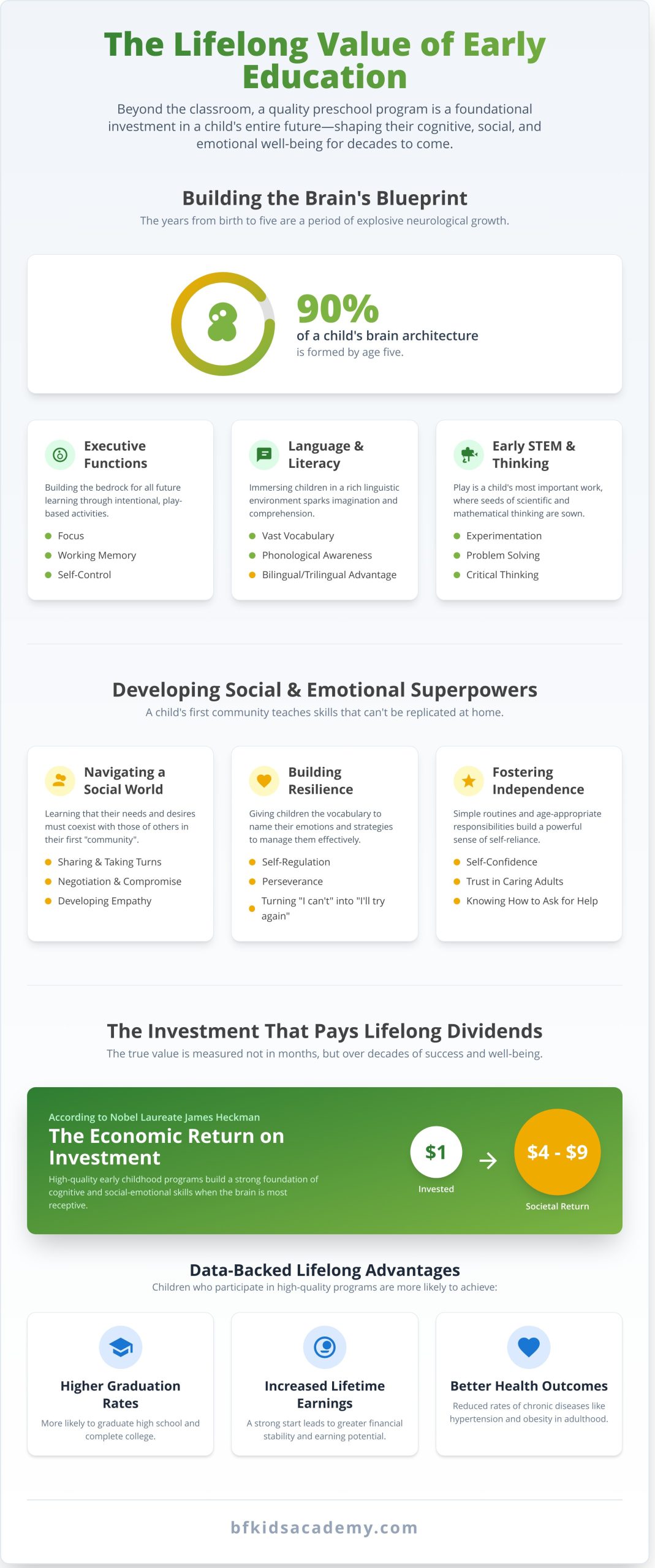
While letters and numbers are important milestones, the true value of early childhood education lies in something much deeper: teaching children how to learn. The years from birth to age five are a period of explosive brain development, where over 90% of a child’s brain architecture is formed. A quality program capitalizes on this critical window not by focusing on rote memorization, but by building the essential executive functions-like focus, working memory, and self-control-that provide the bedrock for all future academic growth.
In a nurturing and structured environment, children don’t just absorb facts; they develop the curiosity and resilience needed to become lifelong learners. Through intentional, play-based activities, we empower young minds to explore, question, and discover the world around them, fostering a genuine love for learning that will serve them for years to come.
Language and Literacy Explosion
A rich linguistic environment is the gateway to academic success. Immersing children in a world of words through stories, songs, and meaningful conversation builds a vast vocabulary and strong pre-literacy skills like phonological awareness-the ability to recognize and work with sounds. Group reading and storytelling do more than teach letters; they spark imagination, enhance comprehension, and build social connection. For children in a bilingual or trilingual setting, this cognitive development is amplified, improving their mental flexibility and problem-solving abilities.
Early STEM and Critical Thinking
Play is a child’s most important work, and it’s where the seeds of scientific and mathematical thinking are sown. When children build with blocks, they are experimenting with physics and engineering. When they sort objects by shape or color, they are engaging with foundational math skills. This holistic approach, which is central to the philosophy of high-quality early childhood education, moves beyond simple memorization. Our dedicated educators guide this discovery process with thoughtful questions like, “What do you think will happen next?” This transforms simple play into a powerful lesson in observation, experimentation, and critical thinking.
The Heart of the Matter: Developing Social and Emotional Superpowers
While academic skills are a visible outcome, the most profound value of early childhood education is rooted in something deeper: the development of social and emotional intelligence. These foundational “superpowers” empower children to manage their feelings, build positive relationships, and navigate the complexities of their world. In a quality early learning environment, children are not just taught; they are guided through a rich landscape of social interactions that simply cannot be replicated at home.
Unlike interactions with loving adults, engaging with peers presents a dynamic and unpredictable social laboratory. It is here, under the gentle guidance of trained educators, that children move beyond parallel play and begin to build the framework for lifelong collaboration and emotional well-being. This holistic development is essential for a smooth transition into kindergarten and sets the stage for future academic and personal success.
Learning to Navigate a Social World
A preschool classroom is a child’s first community. It’s where they learn that their needs and desires must coexist with those of others. Through daily activities, they practice essential social skills like sharing a coveted toy, taking turns on the slide, and working together on a group art project. When conflicts arise, educators help them use their words to express feelings, negotiate compromises, and develop empathy by seeing a situation from a friend’s perspective.
Building Emotional Intelligence and Resilience
Big feelings can be overwhelming for young children. In a nurturing classroom setting, they are given the vocabulary to name their emotions-from frustration to joy-and the strategies to manage them. This process of self-regulation is critical. Developing this emotional resilience helps build the cognitive foundation for lifelong learning that leading researchers emphasize. In a safe environment where trying and failing is part of the process, children learn to persevere through challenges, turning “I can’t” into “I’ll try again.”
Developing Independence and Confidence
Simple routines and age-appropriate responsibilities, such as putting away their own belongings or helping set the table for snack time, foster a powerful sense of independence. Each time a child masters a new skill on their own, their confidence blossoms. They also learn the equally important skill of knowing when and how to ask for help. This supportive setting provides the perfect space for children to practice separating from their parents, building trust in other caring adults and in their own ability to thrive.
The Long-Term Payoff: The Surprising Economic ROI of Early Education
While the upfront cost of an exceptional early learning program can feel significant, it’s one of the most powerful investments a parent can make. This is not just an expense; it’s an investment in your child’s “human capital”-the skills, knowledge, and confidence that will empower them for a lifetime. The true value of early childhood education is measured not in months or years, but over decades of success and well-being.
Groundbreaking research by Nobel laureate economist James Heckman has demonstrated that for every dollar invested in high-quality early childhood programs, society can see a return of four to nine dollars. This incredible return comes from building a strong foundation of cognitive and social-emotional skills when a child’s brain is most receptive to learning.
The Data-Backed Benefits
The data paints a clear and compelling picture of lifelong advantages. Children who participate in enriching, high-quality early education programs are statistically more likely to achieve:
- Higher Graduation Rates: They are more likely to graduate from high school and continue on to attend and complete college.
- Increased Lifetime Earnings: A strong start leads to greater financial stability and higher earning potential throughout their careers.
- Better Health Outcomes: Studies show a link to reduced rates of chronic diseases, such as hypertension and obesity, in adulthood.
- Reduced Reliance on Social Services: This foundation of success makes them less likely to need public assistance as adults.
These outcomes are directly linked to the development of crucial executive function skills-like focus, problem-solving, and self-control-that are nurtured in a structured, play-based learning environment.
Setting the Stage for Academic Success
A strong start prevents the need to play catch-up later. Children who enter kindergarten ready to learn, with a solid foundation in literacy, numeracy, and social skills, are set on a positive academic trajectory. Fostering a genuine love of learning at this stage creates enthusiastic students who are less likely to require future academic intervention, highlighting the profound value of early childhood education from day one.
By choosing a dedicated program, you are giving your child the tools to thrive academically and beyond. Invest in a brighter future for your child. Learn about our programs.
What Does High-Value Education Look Like? A Parent’s Checklist
As a parent, you already understand the importance of a strong start for your child. The challenge lies in identifying a program that truly delivers on its promise. Not all early learning centers are created equal, and recognizing quality is key to unlocking the full value of early childhood education. Think of your center tour as an investigation. While your intuition is important, this checklist will empower you to look for concrete evidence of an exceptional, nurturing environment where your child can thrive.
The Environment: Safety, Stimulation, and Nurturing
The physical space is more than just a classroom; it’s a child’s world for a significant part of their day. It should feel safe, welcoming, and designed for exploration. Look for a setting that promotes both comfort and curiosity.
- Safety and Cleanliness: Is the facility secure, clean, and well-maintained? Look for child-proofed spaces and clear safety protocols.
- Learning Materials: Are there plenty of age-appropriate toys, books, and learning stations that are organized and easily accessible to the children?
- Emotional Atmosphere: Does the center feel happy, calm, and respectful? The emotional tone should be warm and supportive, fostering a sense of belonging.
- Teacher-to-Child Ratios: Are ratios low enough to ensure each child receives the individual attention they need for holistic development?
The Educators: Qualifications and Interactions
Dedicated educators are the heart of any high-quality program. Their passion and expertise are what transform a curriculum into meaningful learning experiences. Observe how the staff engages with the children and with you.
- Credentials and Training: Don’t hesitate to ask about teacher qualifications, experience, and commitment to ongoing professional development.
- Positive Communication: Watch how teachers speak to children. Are they at eye-level, using encouraging language and actively listening?
- Guidance and Redirection: How do they handle conflict or challenging behavior? Look for patient, positive guidance rather than punitive measures.
- Genuine Engagement: Do the educators seem genuinely passionate about their work? Their enthusiasm is contagious and essential for empowering young minds.
The Program: Curriculum and Philosophy
A great program has a clear vision for what children should learn and how they learn best. The curriculum should be a well-balanced roadmap that nurtures cognitive, social, and emotional growth.
- Educational Philosophy: Does the center follow a specific philosophy, like play-based or Montessori? Ensure it aligns with your family’s values.
- A Balanced Day: Look for a daily schedule that blends structured activities, free play, quiet time, and ample outdoor exploration.
- Parent Partnership: How does the center communicate with parents? Look for regular updates, photos, and opportunities for parent-teacher meetings.
- Enriching Programs: Ask about unique enrichment opportunities, such as exposure to multiple languages, arts, and cultural traditions that broaden a child’s worldview.
Ultimately, finding the right fit is about matching evidence with intuition. An exceptional program will not only check all the boxes but will also give you a profound sense of peace and confidence. Seeing this high value of early childhood education in action is the final, most important step. We invite you to schedule a tour to see our commitment to shaping the future with care.
Your Child’s Bright Future Starts Now
Choosing the right early learning environment is one of the most impactful decisions a parent can make. It’s an investment that goes far beyond academics, fostering the crucial cognitive foundations and social-emotional intelligence children need to thrive. Understanding the true value of early childhood education means recognizing its power to shape a confident, curious, and capable individual prepared for a lifetime of success.
At Bright Future Kids Academy, we bring this philosophy to life. Our unique trilingual immersion program in English, Armenian, and Russian opens young minds to the world, guided by a founder with real-world LAUSD teaching experience. In our licensed, family-owned center, your child will flourish in a nurturing atmosphere that feels like a second home, empowering their holistic development.
We invite you to see our commitment in person. See the value in action. Schedule a tour of our Granada Hills campus today! Let’s build a brighter tomorrow for your child, together.
Frequently Asked Questions About Early Childhood Education
Is early childhood education really better than a child staying home with a parent?
While a loving home is foundational, a high-quality early education program provides unique, structured opportunities for growth. In a professional setting, children engage in peer socialization, developing crucial skills like sharing, empathy, and cooperation. Our curriculum is intentionally designed by educational experts to foster cognitive and emotional development that complements parental care. It’s about adding an enriching, supportive environment that empowers a child’s holistic development and prepares them for future academic success.
What is the difference between ‘daycare’ and ‘preschool’?
Though the terms are often used interchangeably, their primary focus differs. A ‘daycare’ traditionally centers on providing a safe, supervised environment for children while parents work. A ‘preschool’ program, in contrast, has a structured educational curriculum at its core. We focus on kindergarten readiness, cognitive development, and social-emotional learning through planned, play-based activities. An exceptional program, like ours, blends the nurturing care of a daycare with the clear academic goals of a preschool.
At what age should my child start a preschool program for maximum benefit?
Many children are ready to thrive in a structured program between the ages of two and a half and three. At this stage, they are often developing greater independence, are eager for social interaction, and can grasp foundational concepts. However, the most important factor is individual readiness. A child who shows curiosity about others and can follow simple instructions may be ready. We believe in a personalized approach to ensure each child’s transition is positive and empowering.
How does a bilingual or trilingual program add extra value for my child?
A multilingual program offers profound cognitive advantages, enhancing problem-solving skills, creativity, and mental flexibility. Early exposure to different languages, like English, Armenian, and Russian in our academy, prepares children for a globalized world and deepens their cultural appreciation. This immersion makes language acquisition feel natural and effortless, providing a powerful foundation for lifelong learning. It is an enriching gift that empowers young minds for a brighter, more interconnected future.
How can I afford high-quality childcare? Are there any support programs?
We understand that this is a significant investment in your child’s future. The long-term value of early childhood education is immense, and there are programs designed to help. Many families can access government subsidies, such as Child Care Assistance Programs (CCAP). Additionally, some employers offer Dependent Care Flexible Spending Accounts (FSAs), which allow you to use pre-tax dollars for tuition. We encourage you to research your state’s resources and speak with our administrators for guidance.
Won’t my child get sick more often in a daycare or preschool setting?
It is common for children in group settings to be exposed to more illnesses initially. However, this exposure helps build a more robust and resilient immune system over time, which can lead to fewer sick days in elementary school. A high-quality, licensed center maintains strict hygiene and sanitation protocols to minimize transmission. We are dedicated to providing a clean, healthy, and safe environment where your child’s well-being is always our highest priority.