

20+ Fun Early Literacy Activities to Prepare Your Preschooler for Success
Does the thought of preparing your preschooler for kindergarten feel a little overwhelming? If you’re not a teacher, it’s natural to worry if you’re doing enough-and to feel frustrated when flashcards and drills are met with yawns. But what if the most effective early literacy activities don’t require expensive supplies or a teaching degree? What if you could build a strong foundation for reading and writing simply by playing together, turning learning into a joyful adventure your child loves?
We are dedicated to empowering parents just like you. In this guide, you’ll discover over 20 simple, fun ideas that support your child’s holistic development. We’ll show you how to transform everyday moments into powerful learning opportunities, and we’ll explain the ‘why’ behind each game so you can see the cognitive growth in action. Get ready to build your child’s confidence, strengthen your bond, and feel reassured that you are shaping their bright future with care and joy.
What is Early Literacy? More Than Just the ABCs
When you think of preparing your child for reading, you might picture flashcards and alphabet drills. But the foundation for academic success is built much earlier, through joyful, everyday moments. The concept of early literacy encompasses everything a child knows about reading and writing before they can actually do either. It’s the rich soil from which future reading skills will grow. As a parent, you are your child’s first and most important teacher, and you already have everything you need to empower them for a brighter tomorrow.
The Five Pillars of Early Literacy Skills
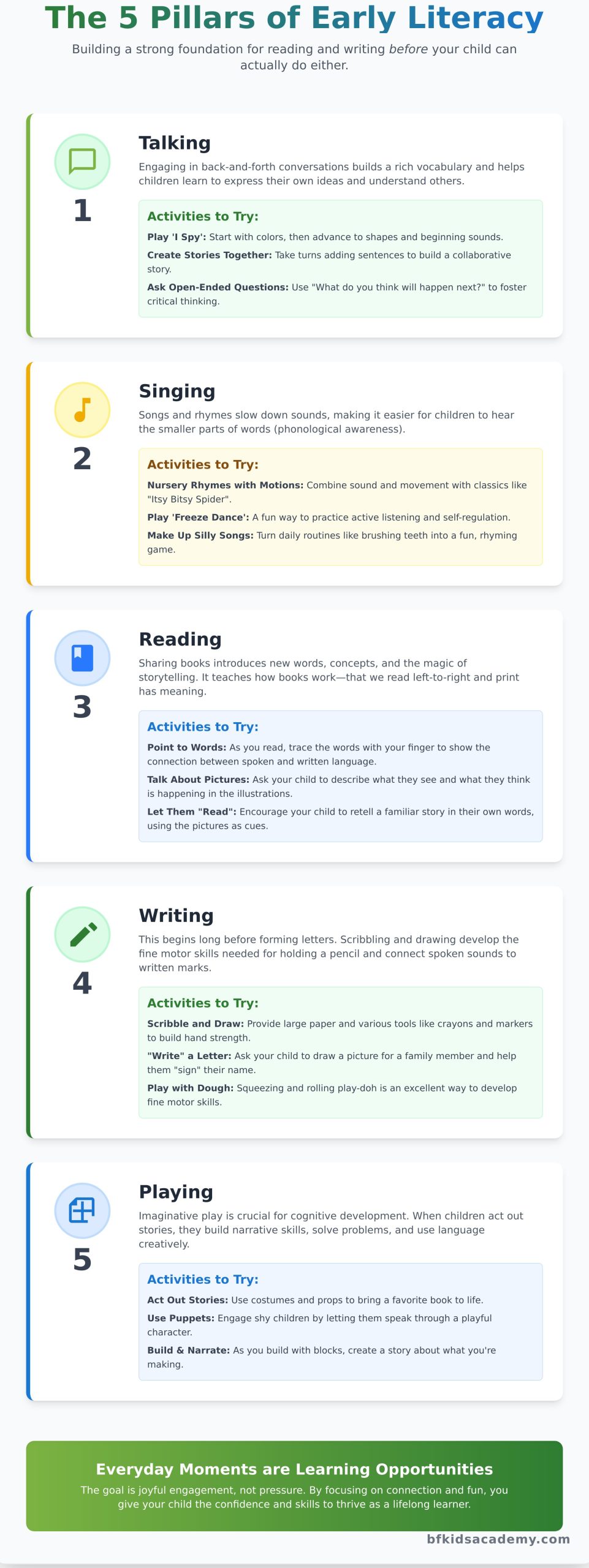
Building a strong foundation for reading isn’t about formal lessons; it’s about incorporating five simple, powerful practices into your daily routine. These pillars work together to support your child’s holistic development:
- Talking: Engaging in back-and-forth conversations builds a rich vocabulary and helps children learn to express their own ideas and understand others.
- Singing: Songs and rhymes are wonderful for developing an ear for language. They slow down sounds, making it easier for children to hear the smaller parts of words.
- Reading: Sharing books together introduces new words, concepts, and the magic of storytelling. It also teaches children how books work-that we read from left to right and that print has meaning.
- Writing: This begins long before a child can form letters. Scribbling and drawing help develop the fine motor skills needed for holding a pencil and connect spoken sounds to written marks.
- Playing: Imaginative play is crucial for cognitive development. When children act out stories, they are building narrative skills, solving problems, and using language in creative ways.
Why Everyday Moments are Learning Opportunities
You don’t need a special curriculum or expensive tools to foster these skills. The most effective early literacy activities are woven into the fabric of your day. Narrating your trip to the grocery store (“Let’s find the big, red apples!”) exposes your child to new vocabulary and concepts. Reading a recipe together while you cook shows them that words have a real-world purpose. These simple interactions are powerful because they are meaningful and connected to your child’s life.
The goal is always joyful engagement, not performance or pressure. By focusing on connection and fun, you are giving your child the confidence and foundational skills they need to thrive as a lifelong learner.
Activities for Talking & Singing: Building a Rich Vocabulary
Before a child can read words on a page, they must first learn to hear the sounds within them. Conversation and music are the cornerstones of this crucial skill, known as phonological awareness. Engaging in these simple, joyful interactions builds a rich vocabulary and empowers your child with the confidence to express themselves. These foundational early literacy activities are powerful tools for cognitive development and can be done in any language, creating a wonderful opportunity to support bilingualism and deepen cultural connections from an early age.
Fun Ways to Get Talking
Every conversation is an opportunity to build a strong language foundation. Focus on back-and-forth communication that encourages your child to think, imagine, and share their ideas. These simple games transform everyday moments into powerful learning experiences.
- Play ‘I Spy’: Start with simple colors (“I spy something blue”) and advance to shapes, and eventually, beginning sounds (“I spy something that starts with the ‘buh’ sound”). This sharpens observation and listening skills.
- Create Stories Together: Start a story with a single sentence, like “Once upon a time, there was a friendly dragon who loved to bake,” and have your child add the next sentence. This collaborative storytelling fosters creativity and sentence structure.
- Ask Open-Ended Questions: During playtime or while reading, ask questions that require more than a “yes” or “no” answer. Try “What do you think will happen next?” or “Why do you think the character did that?”
- Tip: Use puppets or favorite stuffed animals to engage shy children. Sometimes, they feel more comfortable speaking through a playful character, which helps build their conversational confidence.
The Power of Singing and Rhyming
Music and rhythm are not just for fun-they are essential tools for teaching children about the patterns and sounds of language. Singing classic nursery rhymes and silly songs helps children hear the smaller sounds within words, a critical step toward decoding and reading. These simple musical moments are some of the most effective literacy activities and games for building these essential pre-reading skills.
- Sing Nursery Rhymes with Motions: Classics like “The Wheels on the Bus” or “Itsy Bitsy Spider” combine sound with movement, which helps cement learning and makes it more engaging.
- Play ‘Freeze Dance’: Turn on some music and have your child dance, then pause it suddenly. The goal is to freeze in place, which is a fun way to practice active listening and self-regulation.
- Make Up Silly Songs: Create simple, rhyming songs about daily routines. A song about brushing teeth (“Brush, brush, brush your teeth, make them shiny clean!”) or getting dressed makes mundane tasks a fun learning opportunity.
- Tip: Explicitly point out the rhymes in songs. Saying, “Did you hear that? ‘Star’ and ‘are’ sound the same at the end!” helps your child consciously recognize the sound patterns that form the basis of reading.
Interactive Reading Activities: Making Books Come to Life
Transforming story time from a passive task into an interactive journey is one of the most powerful ways to foster a lifelong love of reading. The goal is to explore a book together, not just to get through the words on the page. These shared moments are foundational early literacy activities that build crucial pre-reading skills, including an understanding of how books work. This concept, known as ‘print awareness,’ includes knowing how to hold a book correctly, that we read from left to right, and that the strange squiggles on the page represent spoken words. When you make reading an engaging and multisensory experience, you empower your child to see books as a source of joy and discovery.
Making Story Time an Adventure
Every book holds the potential for a new adventure. By actively engaging your child’s senses and curiosity, you help build their comprehension, observation skills, and confidence. The key is to make it a dynamic dialogue, not a monologue. Try these simple yet effective techniques to bring any story to life:
- Use Your Voice: Create distinct, fun voices for different characters. Whisper during suspenseful parts and be loud and boisterous for exciting moments. This vocal variety captures attention and helps children follow the narrative.
- Pause and Point: Before turning the page, ask, “What do you see here?” or “What do you think will happen next?” This encourages active observation and develops critical thinking and prediction skills.
- Track the Words: As you read, gently run your finger under the words. This simple action is a powerful tool for teaching print awareness, visually connecting the words you speak to the text on the page.
At Bright Future Kids Academy, we believe in creating enriching literary experiences that spark imagination and build a strong foundation for academic growth. Discover our approach to reading at Bright Future Kids Academy!
Playful Letter Recognition Games
Letters are the building blocks of words, and learning to recognize them can be a delightful game. By incorporating letter identification into everyday play, you help your child see that letters are a meaningful and fun part of their world. These hands-on early literacy activities make learning feel effortless and exciting.
- Go on an Alphabet Hunt: Search for letters on signs, cereal boxes, or license plates when you’re around the house or out in the neighborhood. “I see a ‘B’ on that box! Can you find one?”
- Use Magnetic Letters: The refrigerator is a perfect canvas for learning. Use magnetic letters to spell out your child’s name and other simple, familiar words. Starting with the letters in their own name makes the learning process deeply personal and motivating.
- Create Tactile Letters: Get creative by forming letters out of play-doh, arranging sticks and pebbles, or drawing them in sand or shaving cream. This sensory play reinforces letter shapes in a memorable way.
These simple games are just the start. For even more creative ideas, the national literacy initiative Reading Rockets provides a fantastic list of fun reading and writing activities that you can easily adapt for your child. Remember, repeatedly reading favorite books also plays a vital role, as familiarity builds confidence and deepens comprehension with each telling.
Early Writing Activities: Strengthening Hands for Future Success
Before a child can write their name, they must first build the strength and coordination in their hands to hold a pencil correctly. Early writing isn’t about perfect penmanship; it’s about developing the crucial fine motor skills that create a foundation for future academic success. These playful exercises are some of the most effective early literacy activities for empowering your child with the physical tools they need to thrive as a future writer and learner.
The journey begins with simple, joyful movements that build control, dexterity, and confidence. Remember to celebrate every scribble and squeeze-it’s all part of their holistic development!
Building Strong Fingers and Hands
Think of these activities as a fun workout for the small muscles in your child’s hands and fingers. Consistent practice strengthens the pincer grasp-the coordination between the thumb and index finger-which is essential for holding writing tools. Engaging in these hands-on tasks prepares them to tackle writing with confidence.
- Play-Doh Power: Squeezing, rolling, pinching, and squishing modeling clay or play-doh is a fantastic way to build hand and finger strength.
- Tweezer and Tong Transfers: Challenge your child to use child-safe tweezers or tongs to pick up small, soft items like cotton balls or pom-poms and move them from one bowl to another.
- Creative Stringing: Provide a shoelace or piece of yarn and large-hole items like beads or dried pasta for them to string. This refines hand-eye coordination and fine motor control.
From Scribbles to Shapes: Encouraging Mark-Making
Long before children form letters, they make marks. This “mark-making” is the very first stage of writing, and every scribble is a valuable expression of creativity and communication. By providing various sensory-rich early literacy activities, you encourage them to explore how their movements can create lines and shapes. This is where they discover the powerful connection between their actions and a visible result.
- Mess-Free Finger Painting: Let them draw with their fingers in a shallow tray filled with salt, sand, or even shaving cream. For a tasty option, use pudding on a high-chair tray.
- Big Art, Big Movements: Offer chunky crayons, thick markers, and sidewalk chalk. These larger tools are easier for small hands to grip and encourage broad, confident strokes that engage the muscles in their arms, wrists, and hands.
Pro Tip: When they show you their creation, resist asking, “What is it?” Instead, say, “Tell me about your drawing!” This values their work as a form of communication and builds their storytelling skills.
At Bright Future Kids Academy, we integrate these foundational, hands-on activities into our enriching programs to ensure every child builds the confidence and skills needed for a lifetime of learning.
Learning Through Play: Where Literacy Comes Together
While we’ve explored many specific skills, it’s crucial to remember that a child’s most important work is play. This is where all the threads of learning-from recognizing letters to understanding sounds-are woven together into a rich tapestry of experience. Play is the natural, joyful way children practice communication, solve problems, and make sense of their world, creating a powerful foundation for academic growth.
Through imaginative and constructive play, children engage in some of the most effective early literacy activities without even realizing it. They are not just building block towers; they are building the cognitive and social skills essential for becoming confident readers.
Pretend Play for Storytelling
Imaginative play is a child’s first foray into storytelling. When they pretend, they are creating characters, developing plots, and using language to build a world. This process directly strengthens narrative skills and vocabulary in a dynamic, engaging way. You can encourage this at home with simple setups:
- Create a ‘store’ or ‘restaurant’: This encourages conversation, asking questions, and using new vocabulary related to food or shopping.
- Use a prop box: A simple box of old clothes, hats, and scarves can inspire endless role-playing scenarios and character development.
- Act out a favorite book: This is a wonderful way to deepen reading comprehension and help a child internalize story structure-understanding the beginning, middle, and end.
How We Foster Literacy Through Play
At Bright Future Kids Academy, our entire philosophy is built on the power of purposeful play. Our classrooms are intentionally designed as enriching environments where literacy opportunities are seamlessly integrated into every activity. From a cozy book corner filled with culturally diverse stories to accessible writing centers with paper, crayons, and markers, children are empowered to explore language freely.
Our dedicated educators are experts at facilitating play, asking thoughtful questions to extend a child’s thinking and introduce new vocabulary. They transform simple moments into meaningful learning experiences, ensuring our early literacy activities are always joyful and effective. We invite you to see our commitment to holistic development in action. Schedule a tour to see our nurturing, play-based environment!
Shaping a Bright Future, One Story at a Time
As we’ve explored, preparing your child for reading success is about so much more than flashcards. It’s about the joyful moments of connection-the songs you sing, the stories you share, and the playful scribbles that strengthen little hands. Integrating these simple early literacy activities into your daily routine builds a powerful foundation, nurturing not just cognitive skills but a lifelong love for learning and discovery.
At Bright Future Kids Academy, we bring this philosophy to life every day. Our nurturing, play-based curriculum is designed to foster holistic development in a warm, welcoming setting. As a Licensed & Family-Owned academy, we offer a unique Trilingual Program in English, Armenian, and Russian that enriches your child’s world and prepares them to thrive. We are dedicated to empowering young minds for a brighter tomorrow.
Ready to see our enriching programs in action? See how we empower young minds every day. Schedule a tour of our Granada Hills academy!
Frequently Asked Questions About Early Literacy
At what age should I start doing early literacy activities with my child?
You can begin empowering your child with pre-reading skills from birth. Early literacy is not about flashcards; it’s about building a rich language foundation. Simple, daily interactions like reading colorful board books, singing nursery rhymes, and narrating your day (“I’m washing the red apple”) are powerful ways to support their cognitive development. These moments build vocabulary and a positive association with language, which is the cornerstone of learning to read.
What if my child shows no interest in letters or learning to read?
It’s completely normal for a young child’s interest to fluctuate. The key is to avoid pressure and keep learning playful. Instead of formal lessons, embed letters into their interests. If they love cars, point out the “S” on a stop sign. If they enjoy sensory play, trace letters in sand or shaving cream. Following their lead ensures that learning remains a joyful discovery, not a chore, which is essential for building lasting confidence and curiosity.
How much time should we spend on these activities each day?
Consistency is more important than duration. Aim for short, engaging periods of 10-15 minutes at a time, woven throughout your day. A bedtime story, singing songs in the car, or pointing out words on a cereal box are all valuable early literacy activities. This approach fosters organic learning without overwhelming your child, contributing to their holistic development and a love for reading. It makes language and print a natural, enjoyable part of your daily rhythm.
Do I need to buy expensive ‘educational’ toys to help my child learn?
Absolutely not. The most powerful tools for early literacy are free: your voice, your time, and your local library. Engaging in conversation, telling stories, and reading library books together are far more impactful than any single toy. Simple household items like crayons, paper, and even magnetic letters for the fridge provide exceptional, open-ended learning opportunities. Meaningful interaction is the key to empowering your child’s cognitive growth and creativity.
How can I support literacy if English is not our primary language at home?
Building a strong literacy foundation in your home language is one of the best things you can do. Skills like understanding story structure, building vocabulary, and connecting sounds to symbols are transferable to English later on. Read, sing, and tell stories in your primary language. This not only supports their academic growth but also enriches their cultural connection and appreciation. A robust first-language foundation empowers children to thrive in a multicultural society.
What are the key signs that my child is on track for kindergarten readiness?
Kindergarten readiness involves several key pre-reading skills. Look for signs like enjoying being read to, holding a book correctly, recognizing their own name in print, and identifying some letters, especially those in their name. Other positive indicators include the ability to rhyme words (cat, hat) and an interest in scribbling or “writing.” Consistent engagement in fun early literacy activities is the best way to ensure they are developing these foundational skills and will enter school with confidence.