

A Parent’s Guide to Preschool Curriculum: What Your Child Will Learn
Choosing the right preschool can feel like one of the most important decisions you’ll make for your child’s future. You tour different schools and hear terms like ‘play-based,’ ‘Montessori,’ or ‘academic-focused,’ but it can be challenging to understand what these labels truly mean for your child’s daily learning and kindergarten readiness. At the heart of every great early childhood program is a thoughtfully designed preschool curriculum that shapes not just what children learn, but how they discover the world around them.
This guide was created to bring you clarity and confidence on this journey. We will demystify the various educational philosophies, outline the key components of an exceptional program that supports holistic development, and empower you with the right questions to ask during a school tour. Our goal is to equip you to choose the perfect educational foundation that nurtures your child’s unique potential and prepares them to thrive, setting the stage for a lifetime of success.
What Is a Preschool Curriculum? More Than Just Playtime
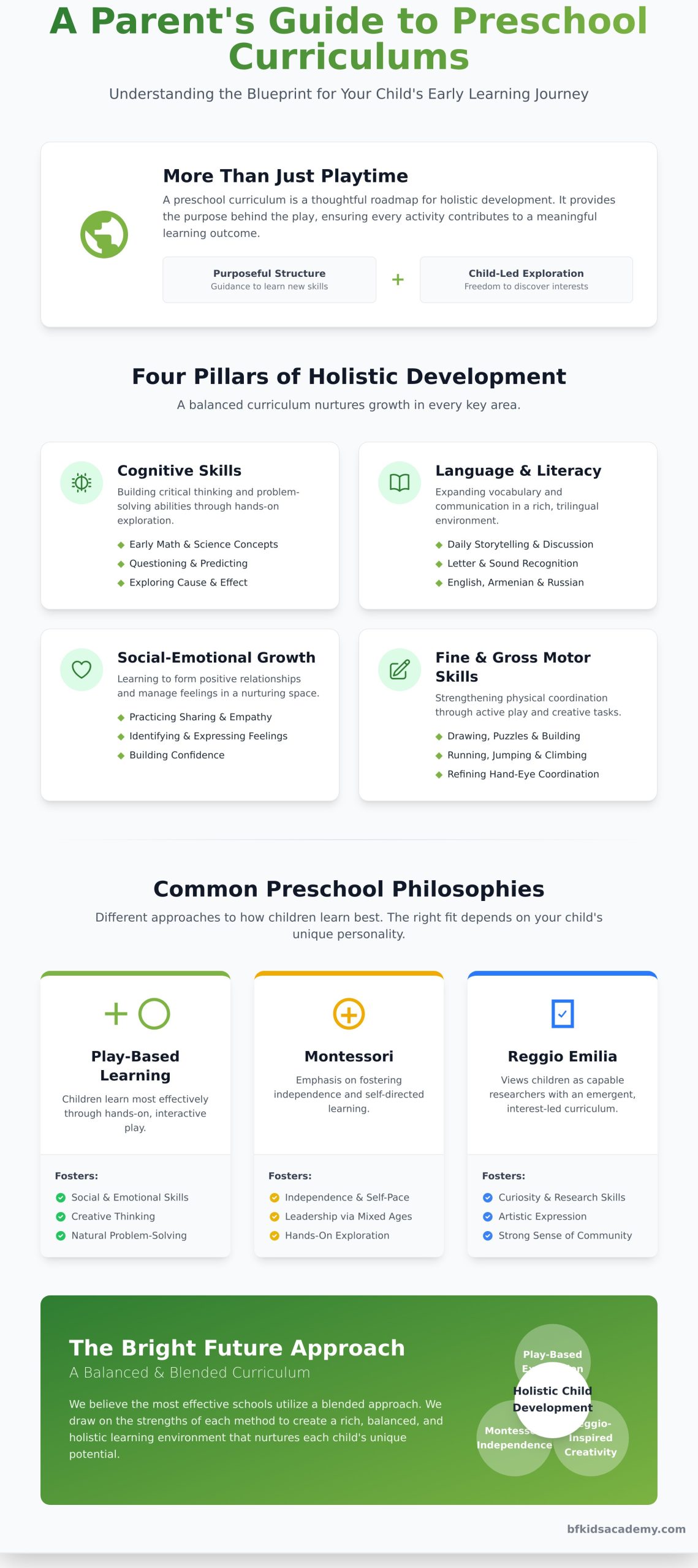
When parents hear the term preschool, they often picture joyful playtime, songs, and art projects. While these activities are essential, they are part of a much larger, intentional framework. A Preschool curriculum is a thoughtful roadmap designed to nurture a child’s holistic development, not just a collection of random daily activities. It provides the structure and purpose behind the play, ensuring every song, story, and building block contributes to a meaningful learning outcome.
At Bright Future Kids Academy, we believe the most effective learning happens when this purposeful structure is balanced with child-led exploration. Our approach empowers young minds by providing both the guidance they need to learn new skills and the freedom they crave to discover their own interests. This balance transforms everyday play into powerful learning experiences.
The Goal: Building a Foundation for Lifelong Learning
The ultimate goal of a high-quality preschool curriculum is to teach children how to learn. We focus on fostering natural curiosity, encouraging creative problem-solving, and building resilience. This foundation is crucial for kindergarten readiness, ensuring a seamless and confident transition to formal schooling. More importantly, it instills a genuine love for learning that will empower your child to thrive for years to come.
Key Areas of Development in a Preschool Curriculum
Our curriculum is carefully designed to support growth across four interconnected domains, ensuring well-rounded and comprehensive development for every child:
- Cognitive Skills: We introduce early math and science concepts through hands-on activities like counting, sorting, and simple experiments. Children develop critical thinking by asking questions, making predictions, and exploring cause-and-effect relationships.
- Language & Literacy: Through daily storytelling, circle time discussions, and exposure to our trilingual environment (English, Armenian, and Russian), children rapidly expand their vocabulary and communication skills. We build pre-reading foundations by recognizing letters, sounds, and rhyming patterns.
- Social-Emotional Growth: Our nurturing environment is the perfect place to practice sharing, taking turns, and developing empathy. Guided activities help children learn to identify and express their feelings in healthy ways, building the confidence to form positive relationships.
- Fine & Gross Motor Skills: From holding a crayon and using scissors to running, jumping, and climbing in our outdoor play area, we provide daily opportunities to strengthen physical coordination. Activities like art, puzzles, and building with blocks refine the fine motor skills essential for writing.
Common Preschool Philosophies: Finding the Right Fit for Your Child
When you begin exploring options for your child’s early education, you’ll find that not all programs are built the same. The foundation of any great preschool curriculum is its educational philosophy-the core beliefs about how children learn best. This underlying philosophy is a critical component that, alongside official state guidelines, shapes your child’s daily schedule and learning experiences. It’s important to remember there is no single “best” approach; the goal is to find an environment where your child’s unique personality will thrive.
Understanding the most common philosophies can empower you to make a confident choice. Many of today’s most effective schools, including Bright Future Kids Academy, utilize a blended approach, drawing on the strengths of each method to create a rich, balanced, and holistic learning environment.
Play-Based Learning
This philosophy is centered on the belief that children learn most effectively through hands-on, interactive play. Our dedicated teachers act as facilitators, skillfully designing a learning environment where play scenarios-like running a pretend store or building a block city-become powerful opportunities. This approach is exceptional for fostering crucial life skills, including:
- Social and emotional development
- Creative thinking and imagination
- Natural problem-solving abilities
Montessori
The Montessori method places a strong emphasis on fostering independence and self-directed learning. Classrooms are carefully prepared environments filled with specific, hands-on materials that children can choose and explore at their own pace. A hallmark of this approach is its mixed-age groupings, where younger children learn by observing their older peers, and older children build confidence and leadership skills by mentoring others.
Reggio Emilia
Originating in Italy, the Reggio Emilia approach views children as capable, curious individuals with a natural drive to research and understand the world. The curriculum is “emergent,” meaning it evolves based on the children’s own interests and questions. This philosophy is distinguished by its deep respect for the arts as a form of expression, its detailed documentation of the learning process, and its strong sense of community between children, teachers, and parents.
What to Look For: The 5 Essential Elements of a High-Quality Curriculum
When evaluating a preschool, the curriculum is the blueprint for your child’s daily experience. A truly exceptional preschool curriculum is a comprehensive framework that supports holistic development, blending academic preparation with social and emotional growth. These elements aren’t just theories in a binder; they come to life in the way teachers interact with children and structure their day. Research-backed models like the HighScope Preschool Curriculum demonstrate how intentional planning across key developmental areas creates a powerful learning environment. Here is a practical checklist to help you identify a high-quality program.
1. Clear Kindergarten Readiness Goals
A great preschool program looks ahead, intentionally preparing children for the academic and social structure of elementary school. This goes beyond ABCs and 123s. Look for a curriculum that actively builds the foundational skills needed to thrive, including:
- Early Literacy & Numeracy: Activities that introduce letter sounds, rhyming, counting, and simple math concepts in an engaging, age-appropriate way.
- Attention & Focus: Opportunities to participate in group storytime, follow multi-step directions, and complete tasks that build concentration.
- Social Preparedness: Practice with classroom routines, raising hands, and working alongside peers on shared projects.
2. Focus on Social-Emotional Development
Academic skills are only one part of the equation. A child’s ability to understand their emotions, cooperate with peers, and navigate social situations is critical for long-term success and happiness. A nurturing curriculum provides daily, structured opportunities for children to practice sharing, take turns, and resolve conflicts with gentle guidance from teachers. This focus empowers children by building empathy, resilience, and strong self-confidence.
3. Rich Language and Cultural Exposure
The preschool years are a crucial window for language acquisition and developing a global perspective. The curriculum should immerse children in a language-rich environment through diverse stories, songs, and conversations. This exposure not only builds vocabulary but also fosters an early appreciation for the vibrant, multicultural world we live in by exploring different traditions and perspectives.
4. Opportunities for Creativity and Critical Thinking
True learning happens when children are encouraged to explore, question, and create. A curriculum that prioritizes curiosity over memorization gives children the freedom to think for themselves. Is there ample time for imaginative play, open-ended art projects, and building with blocks? Do teachers ask thought-provoking questions like, “What do you think will happen next?” These experiences are vital for developing the problem-solving skills that will serve them for a lifetime.
5. Emphasis on Play-Based Learning & Physical Growth
Play is the essential work of early childhood. A high-quality curriculum seamlessly integrates learning into play-based activities, both indoors and outdoors. This approach ensures children are developing crucial fine motor skills (like holding a crayon) and gross motor skills (like running and climbing) while also engaging in joyful, child-led discovery. Look for a balance of structured games and free play that supports both physical health and cognitive development.
A Day in the Life: How Curriculum Shapes Your Child’s Daily Schedule
At Bright Future Kids Academy, a child’s day is much more than just a series of activities; it is a carefully orchestrated journey designed for discovery, growth, and joy. We translate our educational philosophy into a tangible daily schedule where every moment has a purpose. This structure provides children with the reassuring rhythm they need to feel secure, while the activities themselves are designed to spark curiosity and empower learning. Our dynamic preschool curriculum is woven into every part of the day, ensuring your child is constantly engaged in meaningful experiences.
From cheerful morning greetings to fond farewells, you can visualize your child thriving in an environment built to support their holistic development. Here is a glimpse into a typical day with us.
Morning Circle Time: Building Community and Curiosity
Our day begins together in a warm, nurturing circle. This cherished routine builds a strong sense of community and sets a positive tone for the day ahead. It’s where we greet friends, share stories, and introduce the day’s theme, preparing young minds for the enriching activities to come.
- Curriculum in Action: We sing welcome songs in English, Armenian, and Russian to build language skills, discuss the calendar and weather to introduce early math and science concepts, and engage in conversations that foster social-emotional growth.
Learning Centers & Free Play: Empowering Independent Discovery
During this time, your child’s natural curiosity takes the lead. Our thoughtfully arranged learning centers encourage child-led exploration, allowing children to dive deep into their interests at their own pace. This is where they build critical thinking skills, creativity, and confidence as they make choices and discoveries on their own.
- Curriculum in Action: A child at the art easel develops fine motor control, another in the block area explores engineering principles, and friends in the dramatic play corner practice cooperation and social skills.
Outdoor Play & Group Activities: Growing Strong Bodies and Friendships
Fresh air and movement are essential for a thriving mind. Our outdoor time is a vital component of our comprehensive preschool curriculum, designed to develop physical strength, coordination, and social abilities. Whether through structured games or free exploration, children learn to navigate social situations and challenge their physical capabilities in a safe, supervised space.
- Curriculum in Action: Organized group games teach children about following rules and teamwork, while climbing structures and open spaces encourage gross motor development and confident, cooperative play.
The Bright Future Difference: Our Trilingual, Play-Based Approach
At Bright Future Kids Academy, our approach is thoughtfully designed to offer more than a standard education. We have created a unique educational philosophy that blends the proven power of play-based learning with the profound cognitive advantages of trilingual immersion. Our goal is to nurture the whole child-fostering well-rounded, confident, and culturally aware individuals ready for a bright future. This dynamic preschool curriculum is intentionally structured to provide a strong foundation for academic and social success, specifically preparing children to thrive in the diverse schools across Los Angeles. In our warm and professional environment, this exceptional curriculum comes to life.
A Holistic, Play-Based Foundation
We embrace play as a child’s most essential work. It is the most effective tool for learning, discovery, and building critical thinking skills. Our daily activities and learning centers are carefully designed to foster holistic growth, nurturing social-emotional intelligence, cognitive development, physical coordination, and creative expression. We maintain a perfect balance between teacher-guided lessons that introduce foundational concepts and ample time for child-led exploration, empowering children to follow their curiosity and become confident, independent learners.
Unique Trilingual Immersion (English, Armenian, Russian)
Language is the heartbeat of our academy and a gateway to cultural connection. English, Armenian, and Russian are not taught as separate subjects but are seamlessly woven into the fabric of our day. From morning songs and engaging stories to collaborative play and mealtimes, children are immersed in a rich linguistic environment. This approach provides significant cognitive benefits, such as enhanced problem-solving abilities, while cultivating a deep appreciation for the diverse cultures that make our community so vibrant.
Empowering Young Minds for a Brighter Tomorrow
The ultimate goal of our preschool curriculum is to empower your child with the confidence, skills, and academic readiness needed for a successful transition to kindergarten and a lifelong love of learning. We partner closely with parents, providing regular updates and support to ensure each child’s individual learning journey is a success. We are dedicated to shaping the future with care, one child at a time. See our philosophy in action and discover the Bright Future difference. Schedule a tour of our Granada Hills academy today!
Empower Your Child’s Journey with the Perfect Preschool Foundation
Choosing the right path for your child’s early education is one of the most important decisions you’ll make. As we’ve explored, a high-quality curriculum is far more than just playtime; it’s a thoughtful framework designed to nurture holistic development. Understanding the different educational philosophies and essential learning elements is the key to finding a program where your child will truly thrive.
At Bright Future Kids Academy, we bring these principles to life. As a licensed, family-owned center, we offer a unique trilingual immersion program in English, Armenian, and Russian, guided by a founder with direct LAUSD teaching experience. Our play-based preschool curriculum is intentionally crafted to build confidence, spark creativity, and foster a deep appreciation for culture in a safe, nurturing environment.
We invite you to see how we are shaping the future with care. Schedule a tour to see our empowering curriculum in action! Discover the dedicated and professional environment that will prepare your child for a brighter tomorrow.
Frequently Asked Questions About Our Preschool Curriculum
Is a play-based curriculum enough to prepare my child for kindergarten?
Absolutely. A high-quality, intentional play-based curriculum is one of the most effective ways to ensure kindergarten readiness. It goes far beyond free play; our educators design activities that embed foundational academic skills into engaging experiences. For example, building with blocks becomes a lesson in physics and numeracy, while dramatic play develops crucial language and social-emotional skills. This approach nurtures a love of learning and builds the confidence needed to thrive in a more structured classroom.
What’s the difference between a curriculum and a daily schedule?
Think of the curriculum as the “what” and “why” of learning, while the daily schedule is the “when” and “how.” Our curriculum is our educational philosophy-it outlines the developmental goals and learning concepts we want children to explore. The daily schedule provides the structure for that exploration, creating a predictable rhythm with time for group activities, individual discovery, outdoor play, and quiet reflection. The schedule brings our curriculum to life in a consistent, reassuring way.
How can I tell if a preschool is actually following its stated curriculum?
During your tour, observe the classroom environment and the teacher-child interactions. The materials, artwork, and activities should directly reflect the stated philosophy. For a play-based center, you should see children actively engaged in various learning stations. Ask the director for a concrete example: “How does today’s art project connect to your curriculum’s goal of developing fine motor skills?” A dedicated educator will be able to answer this question with passion and clarity.
My child is shy. Which curriculum philosophy is best for them?
For a shy or reserved child, a curriculum that emphasizes a child-led, nurturing approach is often ideal. Philosophies that value individual pacing and small-group collaboration allow quieter children to build confidence without feeling overwhelmed. Our approach provides a safe, supportive environment where every child is encouraged to explore at their own comfort level. This focus on individual development helps shy children find their voice and feel secure as they engage with new friends and activities.
What are the most important questions to ask a director about their preschool curriculum?
To gain a deep understanding, we recommend asking questions that go beyond the surface. Consider asking: 1) How do you assess a child’s progress and communicate that with parents? 2) How do your teachers adapt the preschool curriculum to meet the unique needs and interests of each child? 3) How is cultural diversity and language integrated into daily learning? These questions will reveal the school’s commitment to personalized, holistic, and enriching education.
How does a trilingual curriculum benefit a child’s development?
A trilingual education in English, Armenian, and Russian offers profound cognitive and cultural benefits. Early exposure to multiple languages enhances brain development, strengthening problem-solving, memory, and multitasking skills. Beyond academics, it fosters a deep appreciation for different cultures and perspectives from a young age. This linguistic foundation empowers children with greater empathy and prepares them to thrive as confident, compassionate citizens in our multicultural world.