

Bilingual Daycare: The Ultimate Guide for Parents in 2026
As a parent, you want to give your child every advantage for a bright future. But when considering a bilingual daycare, questions and concerns can quickly surface. Will learning two languages at once confuse them? Could it delay their English development? And how can you be sure you’re choosing a high-quality program that’s truly worth the investment? These are valid concerns that dedicated parents just like you grapple with every day.
We’re here to provide clarity and confidence. This guide, brought to you by Bright Future Kids Academy, is designed to empower you with the knowledge to make an informed decision for your child’s holistic development. We will explore the remarkable, science-backed benefits that an immersive language environment offers, from enhanced cognitive flexibility to a deeper cultural appreciation. You’ll learn exactly what to look for in an exceptional program and gain the assurance that you are giving your child an incredible head start for a brighter, more connected future.
What is a Bilingual Daycare? Understanding the Immersion Model
A bilingual daycare is far more than a traditional childcare center that offers a weekly language lesson. It is a dynamic, enriching environment where a second language is woven into the very fabric of your child’s day-from circle time and snacks to art projects and outdoor play. Many parents wonder if this approach will confuse their child or delay their English skills, but extensive research shows the opposite is true. Instead of causing confusion, early immersion empowers holistic development from the very beginning.
The core of this powerful model is language immersion, an educational method where children learn a second language naturally, the same way they learned their first. By understanding what is language immersion, parents can appreciate how it leverages a child’s innate abilities. An infant’s brain is uniquely wired for language acquisition, capable of absorbing multiple languages simultaneously and without conflict. This early exposure builds a strong foundation for future academic growth and a lifelong appreciation for diverse cultures.
Different Types of Bilingual Programs
When exploring language-focused childcare, you will encounter several models, each offering a unique level of immersion designed to meet different family goals:
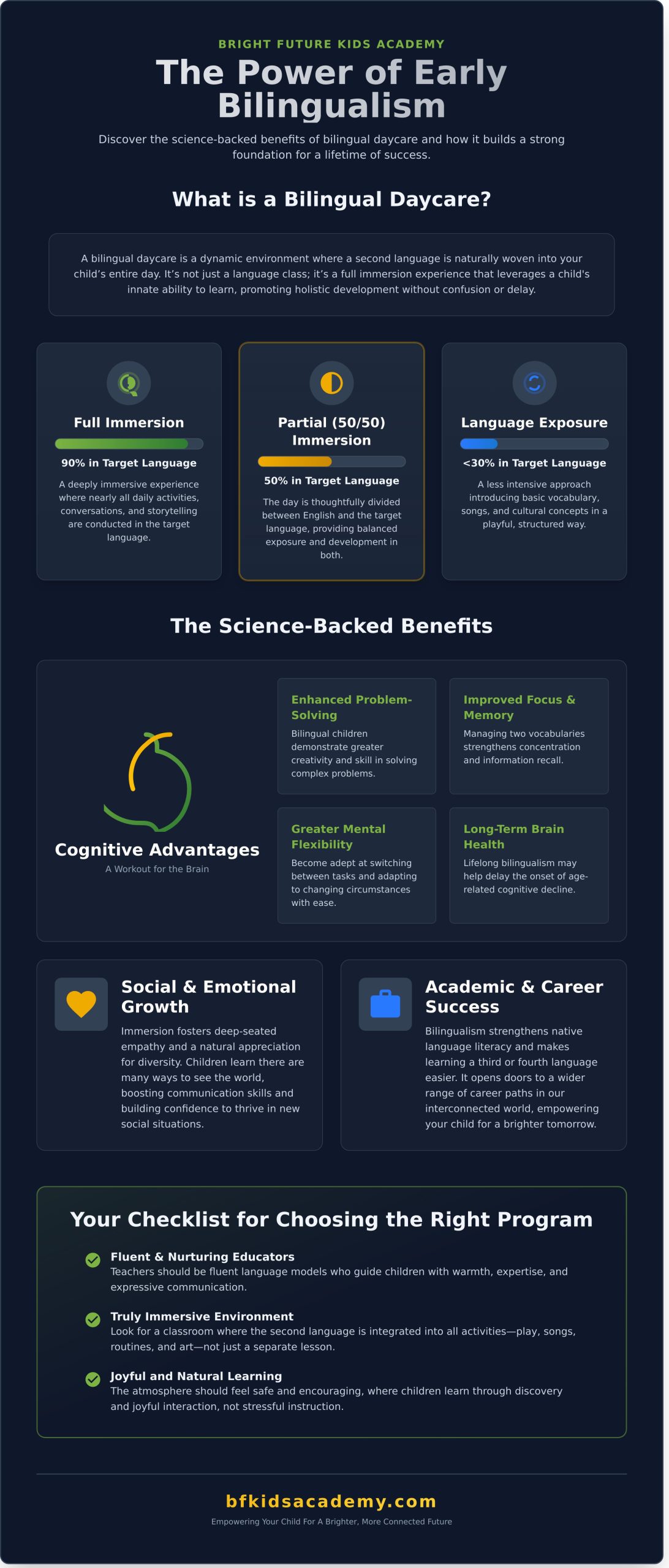
- Full Immersion: At least 90% of daily activities, from conversations to storytelling, are conducted in the target language, creating a deeply immersive experience.
- Partial (50/50) Immersion: The day is thoughtfully divided between English and the target language, providing balanced exposure to both.
- Language Exposure Programs: A less intensive approach focused on introducing basic vocabulary, songs, and cultural concepts from another language in a playful way.
The Role of the Teacher in an Immersion Classroom
In an immersion setting, our dedicated educators are more than instructors; they are fluent language models who guide children with warmth and expertise. They create a safe, nurturing space where children feel confident experimenting with new sounds and words. Using expressive gestures, engaging songs, and predictable routines, they build comprehension naturally, ensuring that learning is a joyful process of discovery, not a stressful lesson.
Bilingual vs. Multilingual Programs
While a bilingual daycare focuses on fostering fluency in two languages (e.g., English and Spanish), a multilingual program introduces three or more. This expanded exposure can further amplify the cognitive benefits, enhancing a child’s mental flexibility, problem-solving skills, and ability to switch between different tasks. It is an exceptional gift that prepares children to not just succeed, but to thrive in our increasingly interconnected world.
The Science-Backed Benefits of Early Bilingualism
Choosing an enriching environment for your infant is about more than just exceptional care; it’s about empowering their potential from the very beginning. While the ability to speak another language is a wonderful gift, the advantages of early bilingualism go much deeper, shaping your child’s cognitive and social development in profound ways. Enrolling your child in a bilingual daycare provides a daily workout for their brain, building a strong foundation for a lifetime of learning and success. The benefits emerge from the process of learning itself, even long before fluency is achieved.
Cognitive Advantages: A Workout for the Brain
A bilingual brain is a more flexible and resilient brain. Constantly navigating between two language systems enhances what scientists call “executive functions.” This mental juggling act strengthens key cognitive skills that are crucial for academic growth. As detailed in comprehensive reviews on The Science of Early Bilingualism by the National Institutes of Health, this early exposure can lead to remarkable advantages, including:
- Enhanced Problem-Solving: Bilingual children often demonstrate greater creativity and skill in solving complex problems.
- Improved Focus and Memory: Managing two vocabularies and rule systems strengthens their ability to concentrate and recall information.
- Greater Mental Flexibility: They become adept at switching between tasks and adapting to changing circumstances with ease.
- Long-Term Brain Health: Exciting research suggests that lifelong bilingualism may help delay the onset of age-related cognitive decline.
Social and Emotional Growth
Language is deeply connected to culture and perspective. When infants are immersed in a multilingual environment, they develop a natural appreciation for diversity. This early exposure fosters a deep-seated empathy, as they learn that there are many ways to express ideas and see the world. This experience boosts their communication skills, both verbal and non-verbal, and builds the confidence to adapt and thrive in new social situations, preparing them to be compassionate and connected global citizens.
Long-Term Academic and Career Opportunities
The developmental benefits gained in a bilingual daycare setting translate directly into future academic and professional success. Surprisingly, early bilingualism has been shown to strengthen literacy skills in a child’s native language. The brain becomes more adept at recognizing language structures, which makes learning a third or fourth language significantly easier later in life. In our increasingly interconnected world, this linguistic and cultural fluency opens doors to a wider range of career paths and opportunities, empowering your child for a brighter tomorrow.
How to Choose the Right Bilingual Daycare: A Parent’s Checklist
Understanding the cognitive and cultural benefits of early language immersion is the first step. Now, it’s time to find the perfect environment where your infant can thrive. Choosing the right bilingual daycare is a significant decision, but it doesn’t have to be overwhelming. This checklist is designed to empower you with the right questions and observational tools, ensuring you can confidently select a program that fosters holistic development and a genuine love for language.
What to Look For in the Classroom
During your tour, pay close attention to the physical and emotional atmosphere. A truly immersive classroom will show, not just tell, its commitment to bilingual education. Look for an environment that is rich with language and culture, where children are visibly happy, engaged, and comfortable. Observe how educators naturally weave the target language into every activity, from playtime to snack time, creating a seamless learning experience.
- Integrated Materials: Are books, posters, and learning materials available and used in both languages?
- Teacher Interaction: Do educators speak the target language consistently and with enthusiasm?
- Cultural Richness: Is the environment filled with cultural art, music, and stories that celebrate diversity?
Key Questions to Ask the Director
A dedicated director will welcome your questions and provide transparent answers about their program’s philosophy and structure. These key inquiries will help you gauge the quality of the curriculum, the expertise of the staff, and the center’s commitment to supporting every child and family on their bilingual journey.
- What are your teachers’ qualifications, fluency levels, and experience in early childhood education?
- What is your specific approach to language immersion (e.g., one person, one language; time-based)?
- How do you support an infant who is just beginning to hear a new language?
- How do you communicate daily progress and important updates with parents who do not speak the target language?
Red Flags to Watch Out For
Just as important as knowing what to look for is recognizing what to avoid. A high-quality bilingual daycare will have a clear, structured, and consistent approach. Be cautious of programs that treat the second language as an occasional activity rather than an integral part of the day. Vague answers or a lack of clear curriculum can indicate a program that is not truly equipped to provide an effective immersion experience.
By using this checklist, you are prepared to find a nurturing and enriching program where your child will flourish. At Bright Future Kids Academy, we are dedicated to these principles of excellence and transparency. We invite you to schedule a tour to see our empowering philosophy in action.
A Day in the Life: What to Expect in a Bilingual Classroom
Many parents wonder what a day inside a bilingual infant program actually looks like. The reality is far from formal lessons and flashcards; instead, it’s a vibrant, nurturing environment where language is woven into every moment of play and discovery. At a high-quality bilingual daycare, the focus is on immersive, context-rich experiences that allow children to absorb new words and sounds as naturally as they learn to walk.
Our approach is designed to build confidence and a genuine love for communication. Here’s a glimpse into a typical day, where holistic development and language acquisition go hand-in-hand.
Morning Circle and Music
The day begins with a warm welcome in multiple languages. During circle time, children greet each other with songs that incorporate English, Armenian, and Russian phrases. Simple, repetitive routines like discussing the weather (“Солнечно!” or “It’s sunny!”) and updating the calendar build a foundational vocabulary. Music and rhythm are powerful tools, making new words memorable and fun while creating a joyful and inclusive atmosphere for every child to thrive.
Play-Based Learning Centers
This is where the magic of immersion truly shines. As children explore enriching activities, our dedicated educators narrate their actions in the target languages. For example, while building with blocks, a teacher might say, “You have a blue block” or “Let’s make a big tower.” In the art center, children learn colors and textures, and in the dramatic play area, they practice social phrases. This constant, meaningful interaction connects words directly to actions, empowering young minds to build comprehension naturally.
Story Time and Meals
Story time transports children to new worlds with culturally diverse books read in their original languages. Vibrant illustrations in picture books help reinforce vocabulary and sentence structures, making reading an engaging and interactive experience. Even mealtimes are a valuable opportunity for learning. Simple, conversational phrases about food and sharing are practiced in a relaxed, social setting, turning a daily routine into another step toward fluency and cultural appreciation.
The best way to understand the empowering environment of our bilingual daycare is to experience it firsthand. We invite you to see how we are shaping the future with care. Schedule a tour of our multilingual academy and see it for yourself!
Your Next Step Toward a Brighter, Bilingual Future
As we have explored, the decision to choose a bilingual daycare is a powerful investment in your child’s cognitive development and global citizenship. From the science-backed benefits that enhance problem-solving skills to the rich cultural immersion that shapes an open worldview, the advantages are profound. By understanding the immersion models and knowing what to look for, you are empowered to make a choice that will shape your child’s future for the better.
At Bright Future Kids Academy, we are dedicated to turning these benefits into a daily reality. As a licensed, family-owned center led by an educator with extensive LAUSD teaching experience, we provide a uniquely nurturing environment for holistic growth. Our trilingual immersion program in English, Armenian, and Russian is designed to help young minds thrive. Discover the power of a multilingual education. Schedule your tour of Bright Future Kids Academy today!
Give your child the gift of language and watch them connect with the world in a whole new way.
Frequently Asked Questions About Bilingual Programs
At what age is it best for my child to start a bilingual daycare program?
The optimal window for language acquisition begins at birth. Starting an infant in a bilingual program capitalizes on their brain’s natural ability to absorb sounds and patterns effortlessly. This early exposure lays a powerful foundation for future fluency and cognitive development. It allows language learning to be an intuitive process, much like learning their first language, rather than an academic subject. The earlier they start, the more naturally they will thrive in a multilingual environment.
Will my child fall behind in English if they are in an immersion program?
On the contrary, extensive research shows that immersion enhances a child’s overall linguistic and cognitive abilities. Learning a second language strengthens the brain’s executive functions, improving problem-solving, multitasking, and focus. These are critical skills that boost academic growth in all subjects, including English. Children in these enriching programs often develop a deeper understanding of language structure, which empowers their command of their native tongue as they grow.
What if we don’t speak the second or third language at home? Will it still be effective?
Absolutely. The immersive environment of a high-quality bilingual daycare is designed to be effective even if you only speak English at home. Our dedicated educators provide consistent, enriching exposure through songs, stories, and play. Your child’s brain will naturally differentiate between languages, and the school environment provides the structured input needed to build a strong foundation. Your role is simply to support their learning journey and celebrate their progress.
How long will it take for my child to start understanding or speaking the new language?
Every child’s developmental journey is unique, but you will see progress in stages. Receptive language (understanding) develops first. Within a few months, your infant may respond to simple commands or names in the new language. Expressive language (speaking) follows later. It is common for children to have a “silent period” as they absorb sounds before they begin speaking words or phrases. This is a natural and essential part of their holistic development.
Are bilingual daycare programs more expensive than traditional ones?
While some bilingual daycare programs may have a higher tuition, it is important to view this as an investment in your child’s future. These programs require highly qualified, multilingual educators and specialized, culturally rich curriculum materials. The exceptional cognitive, social, and cultural benefits provide a significant return, empowering your child with skills that will last a lifetime and help them thrive in our interconnected world. We encourage you to schedule a tour to see the value firsthand.
How do bilingual programs support social skills development?
Bilingual programs are exceptional for fostering social and emotional intelligence. By navigating communication in more than one language, children develop heightened empathy and a greater appreciation for different perspectives. They learn to pay closer attention to non-verbal cues and become more flexible, confident communicators. This experience builds cultural awareness from a young age, preparing them to connect with others and thrive in a diverse global community, truly shaping their future with care.
What is the difference between a bilingual and a dual-language program?
While often used interchangeably, these terms can have different meanings. “Bilingual program” is a broad term for any educational setting where a second language is consistently used. A “dual-language program” is more specific, typically featuring a structured model (like 50/50 or 90/10) with the explicit goal of developing full literacy and fluency in both languages. We recommend asking about the specific immersion model and proficiency goals to find the best fit for your family’s aspirations.