

Kindergarten Readiness: The Ultimate Guide for a Confident Start
The first day of kindergarten is a monumental step, and it’s natural for a wave of questions to follow the initial excitement. “Will my child keep up?” “What do teachers really expect them to know?” “How can I help them feel confident and not stressed?” If these thoughts are on your mind, you are not alone. These questions all circle back to one crucial concept: kindergarten readiness. It’s about so much more than just knowing the ABCs; it’s about nurturing the whole child to ensure they can thrive from their very first day in the classroom.
We understand that preparing your child for this new chapter can feel overwhelming, but it doesn’t have to be. This guide is designed to replace your worries with a clear, confident plan. Inside, you’ll discover the essential academic, social, and emotional skills that truly matter, along with simple, joyful ways to foster their holistic development. Let’s work together to make this transition a smooth and positive adventure, empowering your child for a brilliant start to their educational journey.
What is Kindergarten Readiness? (Hint: It’s More Than ABCs and 123s)
When parents think about kindergarten readiness, flashcards of letters and numbers often come to mind. While academic basics are helpful, true preparedness is a much broader, more beautiful picture. It’s about holistic development-nurturing the whole child so they can thrive in a new learning environment. This approach considers not just what a child knows, but how they interact with the world emotionally, socially, and physically. For a deeper look at the research behind this, Wikipedia offers a comprehensive overview of kindergarten readiness that explores these different domains.
It’s essential to remember that every child develops at their own unique pace. This checklist isn’t a test to be passed, but a guide to empower you. Above all, the most critical skill you can foster is a genuine love for learning. A child who is curious, confident, and eager to explore is truly ready for the adventure of kindergarten. Let’s explore the key areas that build this strong foundation.
Social and Emotional Development: The True Foundation
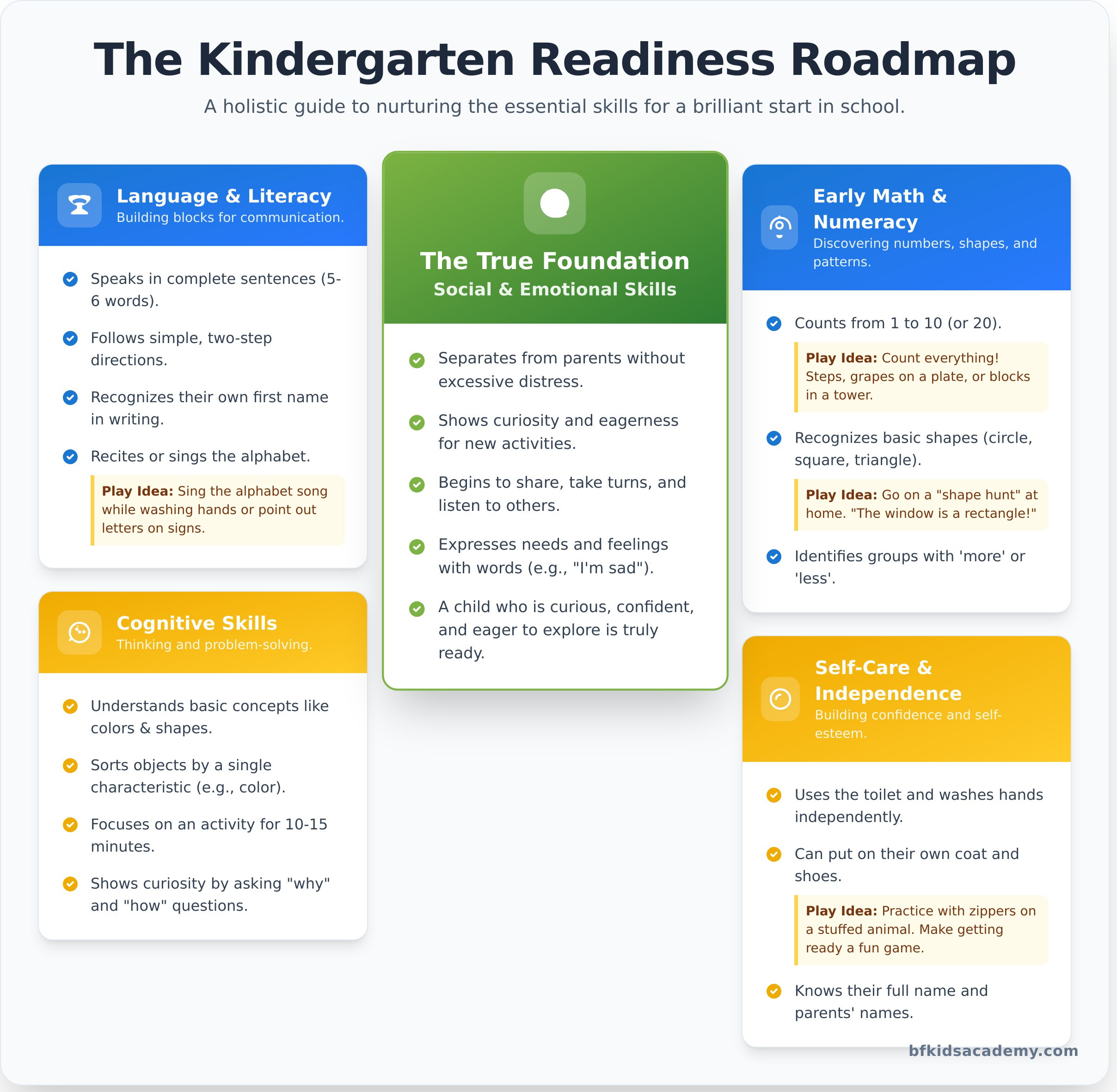
A child’s ability to manage their feelings and build positive relationships is the bedrock of school success. This emotional security allows them to feel safe enough to learn, explore, and connect with their peers and teachers. Foundational skills in this area include:
- Separating from parents or caregivers without excessive distress.
- Showing curiosity and an eagerness to participate in new activities.
- Beginning to share, take turns, and listen while others are speaking.
- Expressing needs and feelings with words, such as “I’m sad” or “Can I have a turn?”
Language and Literacy Skills
Strong communication skills empower children to understand their teachers, express their ideas, and connect with new friends. This isn’t about reading full sentences yet, but about building the fundamental blocks for future literacy. Key milestones include:
- Speaking in complete sentences of five to six words.
- Following simple, two-step directions like, “Please get your coat and line up at the door.”
- Showing an interest in books, listening to stories, and talking about the pictures.
- Recognizing their own first name when it’s written down.
Cognitive Skills: Thinking and Problem-Solving
Cognitive skills are the mental processes that help children understand the world. Fostering these abilities helps your child become an active, engaged learner who thinks critically and solves problems. Look for development in areas such as:
- Understanding basic concepts like colors, shapes, and counting up to ten.
- Sorting objects by a single characteristic (e.g., all the blue blocks).
- Focusing on a preferred activity for at least 10-15 minutes.
- Asking “why,” “what,” and “how” questions to learn more.
The Essential Skills Checklist for Rising Kindergarteners
Preparing your child for kindergarten is an exciting journey of discovery, not a race to a finish line. This checklist is designed to be a gentle guide, offering goals to work toward through play and everyday interactions. True kindergarten readiness is about nurturing the whole child-their social, emotional, and cognitive growth. This holistic view is supported by leading educational frameworks, like the Head Start Approach to School Readiness, which emphasizes that readiness involves the child, the family, and the school working together. Focus on celebrating progress and empowering your child with confidence for the adventures ahead.
Pre-Reading and Literacy Skills
Fostering a love for stories and language is the first step toward academic growth. These foundational skills build the confidence needed to thrive in a classroom setting.
- Recites or sings the alphabet.
Play-Based Idea: Sing the alphabet song while washing hands or driving in the car. Point out letters on signs you see. - Recognizes at least 10 letters, especially those in their name.
Play-Based Idea: Use magnetic letters on the fridge to spell their name and simple words. “Hunt” for the letters of their name in a favorite book. - Understands that words are read from left to right.
Play-Based Idea: As you read a bedtime story, trace the words with your finger so they can follow along. - Can identify rhyming words.
Play-Based Idea: Play a silly rhyming game. “Can you think of a word that sounds like ‘bug’?” (hug, rug, mug).
Early Math and Numeracy Skills
Math is all around us! Integrating these concepts into daily routines makes learning numbers, shapes, and patterns a natural and enjoyable part of your child’s day.
- Counts from 1 to 10 (or 20).
Play-Based Idea: Count everything! Count the steps as you walk up, the grapes on their plate, or the blocks in a tower. - Recognizes basic shapes (circle, square, triangle, rectangle).
Play-Based Idea: Go on a “shape hunt” in your house or neighborhood. “The window is a rectangle! The pizza is a circle!” - Can identify groups with ‘more’ or ‘less’.
Play-Based Idea: During snack time, place two small piles of crackers on a plate and ask, “Which pile has more?” - Understands simple patterns.
Play-Based Idea: Create patterns with LEGOs, beads, or even forks and spoons on the table (fork, spoon, fork, spoon).
Self-Care and Independence Skills
A key part of kindergarten readiness is empowering children to care for themselves. These independence skills boost self-esteem and help them navigate the school day with confidence.
- Uses the toilet and washes hands independently.
Play-Based Idea: Create a fun 20-second hand-washing song to sing together to ensure a thorough clean. - Can put on and take off their own coat and shoes.
Play-Based Idea: Practice with zippers and buttons on a doll or stuffed animal first. Make getting ready a game, not a chore. - Knows their full name and their parents’ names.
Play-Based Idea: Turn it into a simple call-and-response chant. “What’s your super-secret agent name?” “My name is [Child’s Full Name]!” - Cleans up their own toys and materials after play.
Play-Based Idea: Use a “cleanup song.” Challenge them to put all the blocks away before the song ends.
Fostering Social and Emotional Growth for a Smooth Transition
While academic skills are a component, a child’s ability to navigate the social world of the classroom is often the most critical factor for a happy start to school. True kindergarten readiness is built on a foundation of social and emotional intelligence. This holistic view is supported by Head Start’s definition of school readiness, which emphasizes the importance of a child’s ability to manage emotions and interact positively with peers. When children feel secure and can communicate their needs, they are empowered to learn and thrive.
A key part of this emotional development is resilience. Kindergarten presents small, daily challenges-from a crayon breaking to waiting for a turn on the slide. Empowering your child to handle these minor frustrations without a major meltdown builds the confidence they need to tackle bigger learning obstacles. You can practice this by not immediately solving every problem, instead asking, “What could we try next?” This encourages creative problem-solving and self-reliance.
Role-playing is another powerful tool. You can act out common scenarios like asking to join a game, sharing a toy, or what to do if someone is unkind. This gives your child a safe space to practice and a script to follow, reducing anxiety and preparing them to build positive relationships from day one.
Finally, always acknowledge your child’s feelings about this big step. Whether they are bubbling with excitement or feeling nervous, let them know their feelings are valid. Saying, “It’s normal to feel a little nervous about meeting a new teacher, but you are so brave and kind,” provides reassurance and strengthens their emotional security for the transition ahead.
Building Confidence and Independence
A confident child is an engaged learner. You can nurture their independence with simple, consistent practices at home:
- Assign responsibilities: Give your child small, age-appropriate jobs, like setting the table or putting away their toys, to build a sense of capability.
- Encourage self-advocacy: Teach them to try things first but to ask for help when they need it. This is a crucial skill for the classroom.
- Practice making choices: Offer simple choices, such as “Do you want to wear the red shirt or the blue one?” to develop decision-making skills.
- Praise effort, not just outcomes: Focus on their hard work and perseverance by saying, “You worked so hard on that puzzle!”
Developing Positive Peer Interactions
Kindergarten is a highly social environment. You can help your child prepare by focusing on the skills needed to be a good friend and classmate:
- Arrange playdates: Provide opportunities for real-world practice in sharing, cooperating, and taking turns in a familiar setting.
- Talk about friendship: Discuss what it means to be a good friend, such as being kind, listening, and including others.
- Read stories about cooperation: Use books that feature themes of friendship and empathy to spark meaningful conversations.
- Model polite language: Consistently use ‘please,’ ‘thank you,’ and ‘excuse me’ in your daily interactions. Children learn best by your example.
Developing Fine and Gross Motor Skills for School Activities
A crucial part of your child’s holistic development involves strengthening their muscles, both big and small. True kindergarten readiness means preparing the whole child, and that includes their physical abilities. We often separate these into two categories: fine motor skills, which involve small muscle movements in the hands and wrists, and gross motor skills, which use the large muscles in the arms, legs, and torso. Both are essential for empowering your child to thrive in the classroom, on the playground, and beyond.
Fine Motor Skills: Getting Ready to Write and Create
Strong fine motor skills are the foundation for academic tasks like writing, drawing, and cutting. They also foster independence as children learn to manage their own buttons and zippers. By strengthening hand-eye coordination and finger dexterity through play, you are directly preparing your child for the creative and practical demands of the school day. Encourage these simple, screen-free activities:
- Holding a pencil, crayon, or marker with a proper grip.
- Using child-safe scissors to cut along lines or create new shapes.
- Playing with building blocks, puzzles, and play-dough to build hand strength.
- Practicing buttoning, zipping, and snapping on their own clothes or a doll’s.
Gross Motor Skills: Energy for Learning and Play
Developing large muscle groups is vital for more than just recess. Strong gross motor skills build core strength, which helps a child sit attentively during story time, and spatial awareness for navigating a busy classroom. Physical confidence on the playground translates directly to social confidence with peers. These skills help children release energy productively so they can focus better on learning. Fun ways to build these muscles include:
- Running, jumping, skipping, and hopping to improve coordination.
- Throwing, catching, and kicking a ball.
- Practicing balancing on one foot for a few seconds.
- Safely climbing playground equipment to build upper body strength.
By integrating these activities into your daily routine, you provide a powerful, play-based foundation for learning. At Bright Future Kids Academy, our enriching programs are designed to nurture every aspect of a child’s growth, ensuring they have the physical confidence and control needed for complete kindergarten readiness.
How Our Preschool Program Creates a Bridge to Kindergarten
Choosing the right preschool is one of the most impactful decisions you can make for your child’s future success. At Bright Future Kids Academy, we view our role as a dedicated partner in your child’s development, creating a seamless and supportive bridge to elementary school. Our curriculum is intentionally designed to foster holistic growth, ensuring that every child enters their new classroom feeling capable, curious, and confident. We focus on building a complete foundation that goes beyond academics to encompass the social and emotional skills essential for thriving in a new environment.
The Power of a Trilingual Environment
Our immersive English, Armenian, and Russian program offers a profound cognitive advantage. Learning multiple languages enhances mental flexibility, strengthens memory, and sharpens problem-solving abilities. More than that, it opens a window to diverse cultures, nurturing empathy and a global perspective from an early age. This unique environment provides an exceptional head start, preparing children to connect and succeed in our multicultural community.
Play-Based Learning with a Purpose
We believe that children learn best when they are joyfully engaged. Our expert teachers guide purposeful play to achieve key learning objectives in a way that feels natural and fun. Through collaborative activities, children develop crucial social skills like sharing, communication, and teamwork. Activities like building with blocks, storytelling, and artistic expression lay the groundwork for literacy, math, and critical thinking, fostering a lifelong love of learning.
Partnering for a Seamless Transition
A successful transition to kindergarten is a team effort. We are committed to working closely with you every step of the way. You will receive regular, detailed updates on your child’s progress, and our experienced educators are skilled at identifying key readiness milestones. By building a strong sense of confidence in our nurturing environment, we empower children to embrace the adventure of ‘big school’ at local institutions like Granada Charter and beyond, ensuring their kindergarten readiness is comprehensive and secure.
We invite you to see how we are shaping the future with care. Schedule a tour to see our kindergarten prep in action!
Empower Your Child for a Confident Start to Kindergarten
Preparing your child for their first day of school is a significant milestone, and it’s a journey that extends far beyond academics. As we’ve explored, true kindergarten readiness is about nurturing the whole child. It’s about fostering the social confidence to make new friends, the emotional resilience to navigate a new environment, and the fine and gross motor skills needed for classroom activities. This holistic approach ensures children don’t just know their ABCs, but feel secure, capable, and genuinely excited to learn.
At Bright Future Kids Academy, we are passionately dedicated to building this crucial foundation. As a licensed, family-owned academy, our nurturing environment is the cornerstone of our philosophy. We specialize in holistic development, which is enriched by our unique trilingual program in English, Armenian, and Russian. We create a seamless and supportive bridge from preschool to kindergarten, ensuring every child feels prepared to thrive.
We invite you to see our commitment in action. Schedule a tour to see how we empower young minds for a brighter tomorrow! Take the next step in giving your child the gift of a confident and joyful start to their educational journey.
Frequently Asked Questions About Kindergarten Readiness
Is my child behind if they can’t read before kindergarten?
Absolutely not. While recognizing some letters is helpful, teachers do not expect children to be reading on day one. The focus should be on pre-reading skills that build a strong foundation for literacy. This includes fostering a love for books, being able to listen to a story, recognizing their own name in print, and understanding that letters make sounds. True kindergarten readiness is about curiosity and an eagerness to learn, not mastering skills before they are taught.
What is more important for kindergarten readiness: academics or social skills?
While basic academic exposure is beneficial, social-emotional skills are the true foundation for a successful transition to kindergarten. A child who can share, take turns, listen to a teacher, and express their needs is better equipped to learn in a group setting. These skills empower children to navigate the classroom environment with confidence, making them more available for academic growth. At Bright Future Kids Academy, we focus on holistic development, nurturing both social and cognitive skills for complete kindergarten readiness.
How can I ease my child’s separation anxiety about starting kindergarten?
Easing separation anxiety starts with creating a sense of familiarity and predictability. Visit the school playground, read positive stories about starting kindergarten, and talk excitedly about the new friends they will make. Establish a short, loving, and consistent goodbye routine, such as a special hug and a wave from the door. Your confidence is contagious; when you reassure your child that they will be safe and have a wonderful time, it empowers them to feel secure.
What if my child is born late in the year? Should I wait to enroll them?
This is a personal decision that should be based on your child’s individual development, not just their age. Consider their social maturity, emotional regulation, and ability to follow directions in a group. Do they show interest in structured learning? Can they manage their personal needs? Consulting with their preschool teacher can provide valuable insight. The goal is to set your child up for success, whether that means starting now or giving them an extra year to grow.
How does a trilingual program like yours specifically help with kindergarten readiness?
Our trilingual program provides a powerful boost to cognitive development. Learning English, Armenian, and Russian simultaneously enhances a child’s problem-solving abilities, memory, and mental flexibility. This linguistic agility prepares them to adapt quickly to new concepts in the classroom. Furthermore, it fosters an early appreciation for diverse cultures and communication styles, which is an invaluable social skill that helps children connect with peers and thrive in a multicultural school environment from day one.
What are the top three things a kindergarten teacher wishes every child knew on day one?
Teachers prioritize independence and basic social skills. First, they wish children had basic self-care abilities, like using the restroom independently and managing their own jacket and backpack. Second is the ability to follow simple, two-step directions (e.g., “Please get your lunchbox and line up at the door”). Finally, and most importantly, they hope children know how to ask an adult for help when they need it, whether they feel unwell or are struggling with a task.